
content
- Introduction to Rich Web-based Applications
- Delta-Communication technologies
- Architecture
- SPDC/AJAX
- Case study
Rich Internet Applications(RIAs) vs Rich web-based Applications
A rich Internet application (RIA) is a Web application designed to deliver the same features and functions normally associated with deskop applications. Furthermore RIAs generally split the processing across the Internet/network divide by locating the user interface and related activity and capability on the client side, and the data manipulation and operation on the application server side.
A rich web application is a Web application that has many of the characteristics of desktop application software, typically delivered by way of a site-specific browser, a browser plug-in, an independent sandbox, extensive use of JavaScript, or a virtual machine
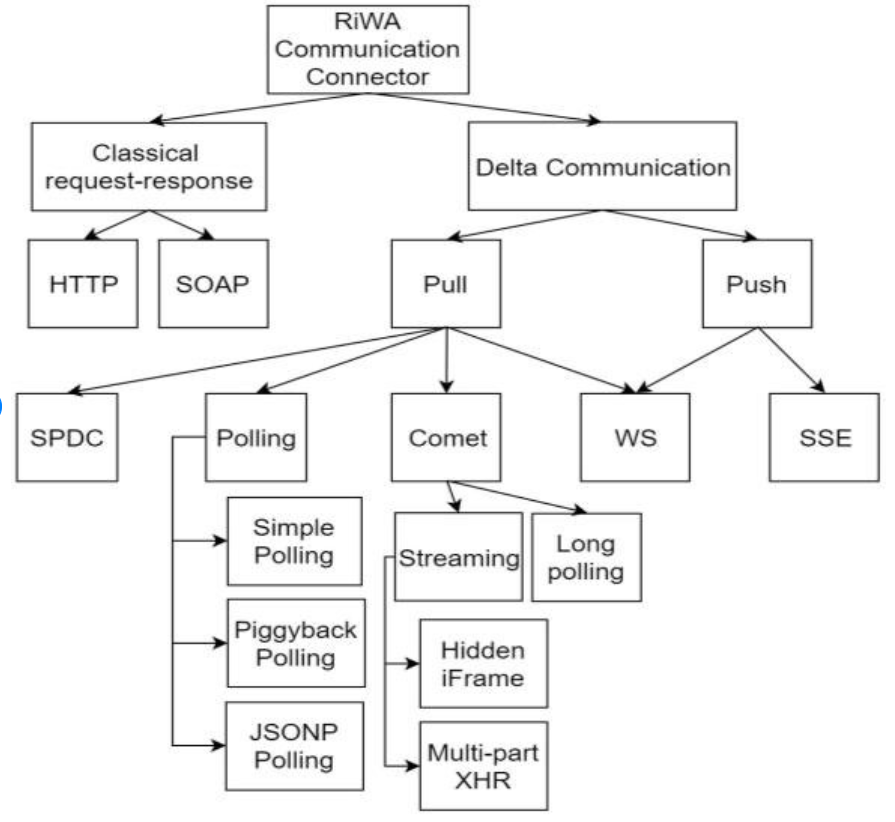
Client side Development technologies
Rich and interactive portal web applications use a variety of technologies such as Ajax, JavaScript, JSON, and patterns such as REST. Moreover for developers these technologies and patterns allow to create increasingly responsive and highly interactive web applications.
Javascript
JavaScript is used to enable client-side interactivity. JavaScript is a loosely typed, compact, language that i web developers are commonly used. Moreover JavaScript has become widely adopted in recent years largely because new frameworks and best practices have proliferated. The emergence of JavaScript toolkits, such as Dojo, make client-side development easier while hiding many of the problems surrounding cross-browser compatibility.
AJAX
Ajax refers to a collection of standards-based and open source browser technologies. While a classic web application refreshes the entire web page with each response from the server,moreover an Ajax-enabled web application allows small amounts of data and UI markup to be returned from the server and rendered in the browser without refreshing the entire page.Furthermore to the user, an Ajax-enabled web application responds more smoothly and quickly than a traditional web application.
At the heart of Ajax is the XMLHttpRequest object. Moreover it is referred to as XHR, XMLHttpRequest is an HTTP request object that makes asynchronous (typically), incremental requests to the server. The JavaScript API for XMLHttpRequest is a key component of Ajax-style web applications. Furthermore this object allows the browser to respond to user events without reloading the entire page. For instance, a web application that allows users to explore folders in a content repository can be designed so that only the explorer part of the interface refreshes each time the user opens a folder.
Disk java script frame work
Disc is a WLP-specific, public JavaScript API for portlet development and interaction with the WLP rendering framework.Moreover Disc helps you write Ajax-enabled portlets and enable richly interactive web application features for your portal.
Portal-aware XMLHTTPREQUEST
When standard XHR objects are used in a portal environment, certain rendering, interportlet communication, and other problems can occur. XHR calls are scoped to an entire portal, while portal-aware XHR calls are scoped to individual portlets. A portal-aware XHR call retrieves some portion of a portlet’s content and of any other portlets that are affected.
The Disc API class, bea.wlp.disc.io.XMLHttpRequest, is an extension of the standard XMLHttpRequest class. WLP’s XMLHttpRequest allows you to make asynchronous, incremental calls to the portal server, and supports portal features such as interportlet communication and WSRP.
Web-based & Rest style services
Representational State Transfer, or REST, is an architectural style for interacting with resources at a given URL. A REST architecture is typically used to provide a simple HTTP interface to resources published on the web. Although a simplistic analogy, you can think of REST services as an easy-to-use equivalent to traditional web services.
The primary advantage of using REST style services with web applications, such as WebLogic Portal, is that REST allows the web application to access web-addressed data and UI directly from the browser interface. The REST model provides a loose coupling between the data and the UI. REST services are easy to invoke using an HTTP request from a browser.
WebLogic Portal provides a REST framework that exposes WLP data and methods as REST services which unlock data from a portal web application and allow the data to be shared between applications.
JSON
JavaScript Object Notation (JSON) is a data exchange format based on JavaScript. JSON is commonly used to pass objects between web clients and servers over HTTP. using JavaScript, JSON objects are easy to read and to manipulate .
AJAX Tool kit
You can use available JavaScript toolkits and frameworks with Disc. As an example, Dojo is a toolkit for DHTML and JavaScript browser programming. Dojo provides low-level IO (XMLHttpRequest), an event framework, JavaScript extensions, and a rich set of interface widgets such as buttons, lists, forms, and trees. for use in WLP portlets , Dojo works well.
Delta communication
Simple Pull Delta-Communication is the basic abstract Delta-Communication technique, based on the data-pull mode.Moreover based on the request-response model; and this technique is technology independent , It describes the simplest form of data-pull Delta-Communication.
Asynchronous Transmission vs Synchronous Transmission
Asynchronous Transmission. In the case of asynchronous transmission, the data or signals being transmitted and received are not done in synchronization. Furthermore the time interval between the sending and receiving devices enable transmission and reception at their own pace.
The word synchronous refers to things happening at the same time. It is true for synchronous transmission within the context of information technology. Furthermore Synchronous transmission defined as the process by which data or a signal is transferred from one application system or device to another at constant periods or intervals, usually monitored by a clock. This means that the transmitting and receiving systems send and receive data at the same rate or speed. They are in sync. Example of this is copying data from one file location to another:

In this diagram, data is being transmitted from A to B, A being the sender and B being the receiver. A couple of sync data packets initialize the transmission process. The sync packets, once received by the receiver, are decoded and serve to synchronize the receiving clock with the sending clock. Sending and receiving commences, once synchronization is achieved .
XHR
XMLHttpRequest (XHR) is an API in the form of an object whose methods transfer data between a web browser and a web server.Moreover the object is provided by the browser’s JavaScript environment.
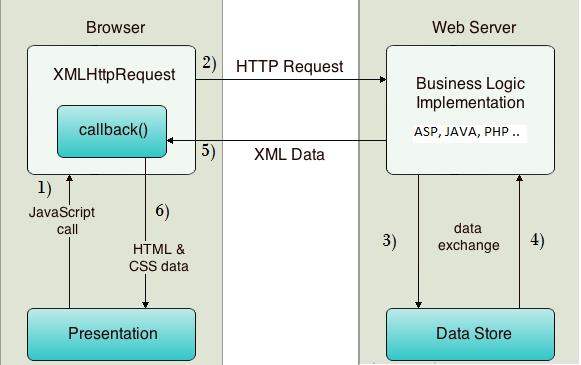
AJAX
AJAX stands for Asynchronous JavaScript and XML. AJAX is a new technique for creating better, faster, and more interactive web applications with the help of XML, HTML, CSS, and Java Script. Along with Document Object Model and JavaScript for dynamic content display Ajax uses XHTML for content, CSS for presentation .
References
https://docs.oracle.com/cd/E15919_01/wlp.1032/e14229/ria.htm
https://pdfs.semanticscholar.org/e0a5/1711458fed342b19311f9f4928026bc264cf.pdf

 Dev's blog